




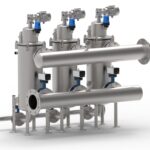

Self-cleaning filters: less maintenance, more efficiency
By Marc Jansen, JMF-Filters BV
The demand for efficiency and cost savings in industrial processes continues to grow. Companies are constantly looking for ways to increase productivity and minimize downtime. Self-cleaning filters offer an ideal solution in this regard, as they perform automatic maintenance without the need for manual intervention. In this blog, we discuss the benefits, technologies, and application areas of these innovative filters.
What are self-cleaning filters?
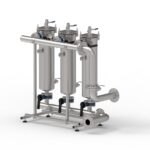
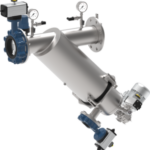
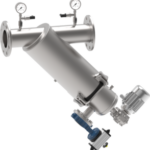
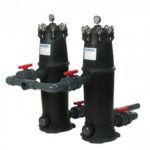
Self-cleaning filters are advanced filtration systems that automatically remove contamination without the need to interrupt the process for manual cleaning. These systems are often used in industrial environments where continuity and efficiency are critical. When the filter becomes full of dirt particles, an internal mechanism, such as brushes, spray nozzles or suction pads, activates the cleaning cycle. This automatically removes the solid particles and maintains optimal flow.
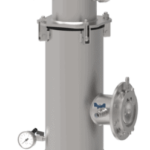
Self-cleaning filters can come in different materials, such as stainless steel (SS) 304 or 316, which makes them suitable for a wide range of industrial applications. In addition, they can be installed inline or in a bypass, depending on specific process requirements.
Benefits of self-cleaning filters
1. Less maintenance and lower costs
The biggest advantage of self-cleaning filters is the automatic cleaning function. Traditional filter systems often require regular maintenance, with filters having to be manually cleaned or replaced. This not only leads to machine downtime but also incurs significant maintenance costs. With a self-cleaning system, this process is automated, resulting in lower operating costs and less need for labor-intensive maintenance work.
2. Continuity and efficiency
Automatic cleaning allows these filters to run continuously without having to be turned off. This ensures better flow and more stable operation of the entire system. For companies that depend on non-stop production processes, such as in the petrochemical industry or water treatment, this is a great advantage. After all, fewer interruptions lead to higher productivity and lower downtime.
3. Environmentally friendly solution
Self-cleaning filters also contribute to more environmentally friendly operations. Because the filters clean themselves, fewer resources are used to replace or clean the filters. In addition, these systems can often contribute to better waste stream management by efficiently removing solids in process water. This ensures cleaner discharges and a lower impact on the environment.
Technologies behind self-cleaning filters
There are several technologies used in self-cleaning filters to achieve automatic cleaning. Each of these technologies has its own specific advantages and areas of application:
- Suction pad technology: This technology uses a suction mechanism that sucks dirt from the filter surface when a certain level of contamination is reached. The system detects this through a built-in sensor that measures the differential pressure.
- Brush technology: In brush filters, a mechanical brush is used to remove solid particles from the filter media. This method is especially effective in systems where coarse particles need to be removed.
- Spray Nozzle Technology: This system uses nozzles that spray water at high pressure onto the filter to flush out dirt particles. This type of technology is ideal for applications where fine particles must be removed from the fluid stream.
- Hybrid systems: Some self-cleaning filters combine multiple technologies to efficiently filter both coarse and fine particles.
Applications of self-cleaning filters
Self-cleaning filters are used in numerous industries, including:
- Petrochemical industry: Here they are used to de-solidify oils, chemicals and other substances, extending equipment life and reducing breakdowns.
- Water treatment: In water treatment plants, self-cleaning filters help remove dirt and sediment from wastewater and surface water, improving water quality and making the treatment process more efficient.
- Food industry: These filters ensure consistent quality of water and liquids used in production processes. It prevents contaminants from entering the final product.
- Automotive industry: Self-cleaning filters are often used to clean process fluids, such as coolants and lubricants, contributing to longer machine life.
Self-cleaning filters at JMF Filters
Self-cleaning filters offer an efficient and cost-effective solution for a wide range of industries. Through their automatic cleaning mechanisms, they help companies reduce maintenance costs, increase efficiency and reduce environmental impact. Whether in the petrochemical, water treatment or food industries, these innovative filtration systems reduce maintenance and increase productivity.
Consider switching to self-cleaning filters to take your process to the next level.For more information on how self-cleaning filters can optimize your business processes, check out the range at JMF Filters.

Marc Jansen



 Expert Filtration Solutions at Your Fingertips
Seeking expert advice on oil and gas industry filters? Reach out to us for a customized solution and quote. Our team of filter specialists is ready to assist you around the clock.